

The world’s largest mining excavators include the Caterpillar 6090 FS, Liebherr R 9800, and Komatsu PC8000-11. Weighing hundreds of tonnes, they use buckets that can exceed 60 cubic meters to load haul trucks in fewer passes. You’ll size them by operating weight and bucket capacity, then match their reach and payload to site conditions. With coordinated trucks, maintenance, and fleet monitoring, they can move thousands of tonnes daily. The sections ahead explain where they work and how they shape mine operations.
Which Mining Excavators Are the Largest?
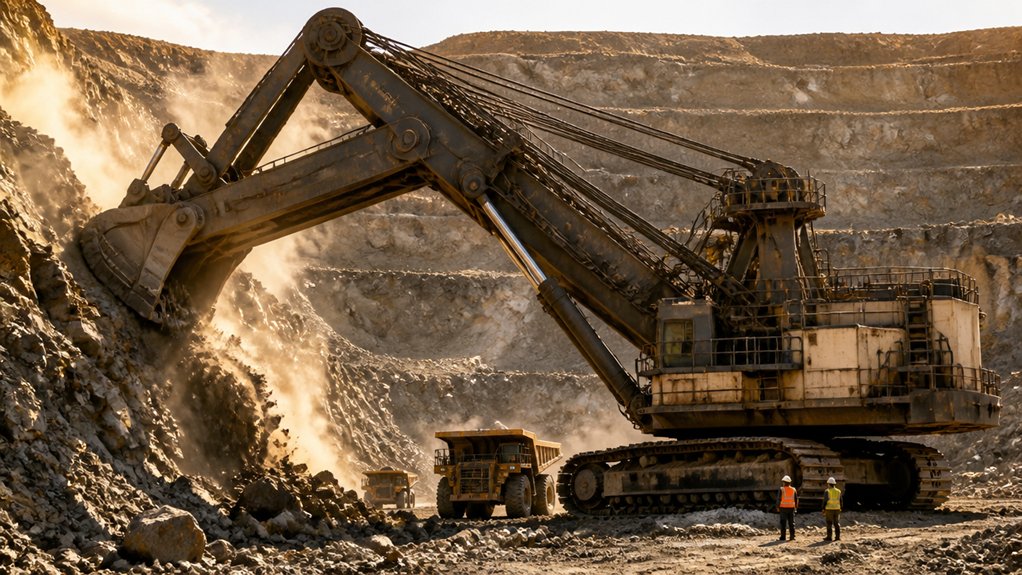
The largest mining excavators are measured mainly by operating weight, bucket capacity, and digging force—not by size alone. Models such as the Caterpillar 6090 FS, Liebherr R 9800, and Komatsu PC8000-11 lead this class. Each machine can weigh hundreds of tonnes and move enormous loads in demanding open-pit operations.
You’ll find that manufacturers configure them with either hydraulic or electric drives, depending on site infrastructure and operating priorities. Their large buckets help you load ultra-class haul trucks in fewer passes, while powerful hydraulic systems support continuous digging in hard material.
Excavator innovations, including improved control systems and energy-efficient drives, can raise productivity and reduce operating costs. Their Mining industry impact is substantial: these machines shape fleet planning, production rates, and infrastructure needs.
Choose a model to match your ore, trucks, and site conditions.
How Is Mining Excavator Size Measured?
Although overall dimensions matter, mining excavator size is measured chiefly by operating weight and bucket capacity. Operating weight includes the machine, standard equipment, and working fluids; it indicates ground pressure, transport demands, and the scale of supporting infrastructure you’ll need. Manufacturers may report weight differently, so compare specifications using consistent configurations.
Bucket capacity describes the volume the excavator can handle per cycle, but don’t treat it as a standalone measure of productivity. Material density, fragmentation, and payload limits affect how much you can move safely.
Mining technology also lets you monitor machine loads and operating conditions, helping you match equipment to site requirements. Check duty ratings and service documentation before selecting a model.
Excavator maintenance records matter, too: component wear and configuration changes can alter operating weight and performance over time. Verify current specifications with the manufacturer.
How Do Their Buckets and Reach Compare?
Bucket capacity and reach vary by model and configuration, so compare them under the same duty conditions. On the largest mining excavators, bucket volumes can span roughly 20 to more than 60 cubic meters, depending on machine class and material density.
A larger bucket isn’t automatically better: match its capacity and cutting edge to the excavator’s rated load, rock size, and dig resistance.
Reach depends on boom, stick, and bucket geometry. Check maximum digging depth, working radius, and dump height against your bench layout and truck position; these limits determine where you can dig and place material safely.
Excavator arm technology, including linkage design and hydraulic control, affects digging force and precision.
For longer component life, use suitable teeth and liners, inspect wear regularly, and apply bucket wear prevention practices suited to abrasive ore.
How Much Material Can They Move Daily?
To estimate daily output, multiply bucket capacity by tons per load and completed cycles.
Your actual daily tonnage depends on operating hours, material density, and cycle time.
Use these figures to compare excavators under realistic site conditions.
Daily Tons Moved
Daily output depends on more than an excavator’s bucket size: cycle time, material density, operator skill, and truck availability all affect how much it moves.
To estimate daily tons, multiply the average tons loaded per truck by completed truckloads per shift, then account for operating hours, delays, and planned downtime.
A large mining excavator may help a well-coordinated fleet move thousands of tons in a day, but no single figure applies across sites.
You’ll get reliable production estimates from shift records, payload data, and cycle-time monitoring—not manufacturer claims alone.
Excavator maintenance matters: worn components, hydraulic faults, or missed service can reduce availability and daily output.
You should also track fuel use and idle time; efficient scheduling can lower costs and environmental impact without compromising safe loading or equipment life.
Bucket Capacity
How much material can a mining excavator move in a day? Bucket capacity helps you estimate the answer, but it isn’t a daily production figure by itself. The largest machines may carry roughly 40 to 80 cubic yards per pass, depending on model and bucket configuration.
To estimate payload, multiply bucket volume by material density, then account for fill factor and spillage. Match the bucket to the haul truck: an appropriate number of passes fills the truck without overloading it or leaving capacity unused.
Rock type, fragmentation, and digging conditions affect how completely each bucket fills. You’ll also need to think about wear: a damaged or poorly maintained bucket can reduce effective capacity and raise operating costs.
Schedule excavator maintenance, inspect teeth and cutting edges, and select bucket designs suited to the material. Mining safety requires controlled loading and stable truck positioning.
Operating Hours
Although a large mining excavator may operate around the clock, scheduled maintenance, shift changes, and delays reduce productive hours. To estimate daily output, multiply effective operating hours by the machine’s average cycle rate and bucket payload, then account for material density and fill factor.
A 100-tonne payload moved every 30 seconds would imply 12,000 tonnes across ten uninterrupted hours, but real production will be lower. You’ll need site-specific records to set a reliable target: haul-truck availability, digging conditions, swing distance, and operator technique all affect cycles.
Maintenance schedules help limit unplanned downtime, while operator training improves safe, consistent loading. Track tonnes per operating hour and compare shifts to identify bottlenecks.
Don’t treat rated bucket capacity as daily production; actual output depends on the entire loading system.
Where Do the Largest Mining Excavators Work?
You’ll find the largest mining excavators in operations that move vast volumes of material, including Canada’s oil sands and Australia’s iron ore mines.
Chilean copper operations also deploy these machines to handle large-scale excavation.
The site’s geology, mine layout, and production targets determine where they’re most effective.
Canadian Oil Sands
Where do the world’s largest mining excavators work? In Canada’s oil sands, you’ll find them at vast surface mines near Fort McMurray, Alberta. Operators use these hydraulic shovels to remove overburden and load oil-sands ore into haul trucks, often weighing hundreds of tonnes. Their reach and bucket capacity help keep high-volume extraction moving across deep, layered deposits.
You’ll see fleets working in harsh conditions, where cold, abrasive material and long operating cycles demand durable components and disciplined maintenance. Advanced monitoring systems track machine health, payload, and fuel use, helping crews reduce downtime and improve loading accuracy.
These technological advancements also support safer operations and more efficient energy use. Environmental impact remains a central concern: you’ll need to account for land disturbance, emissions, and reclamation as mines expand and equipment operates.
Australian Iron Ore Mines
In Western Australia’s Pilbara region, the world’s largest mining excavators work in vast open-pit iron ore mines near centres such as Newman and Tom Price. You’ll find these machines stripping overburden and loading iron ore into haul trucks across benches designed for safe, efficient cycles.
Their high-capacity buckets and hydraulic systems help operators move substantial volumes in the region’s hard, abrasive ground. Mining technology links excavator controls, fleet dispatch and condition monitoring, helping you reduce idle time and plan maintenance before failures disrupt production.
Mine operators also coordinate excavators with crushers and truck routes to keep material flowing. Environmental impact remains a key operating constraint: you’ll need to manage dust, fuel use, noise and disturbed land through monitoring, water controls and progressive rehabilitation.
These practices support reliable output while limiting local impacts.
Chilean Copper Operations
Across Chile’s Atacama Desert, large mining excavators work in open-pit copper operations near sites such as Escondida and Chuquicamata. These machines remove overburden and load blasted ore into haul trucks, keeping high-volume production moving across steep, terraced benches.
You’ll find their performance depends on matching bucket capacity, digging force, and cycle time to rock conditions and truck size. At high altitude, operators and maintenance teams must account for reduced engine cooling, dust, and demanding access routes.
Mining technology, including fleet monitoring and machine health systems, helps you track fuel use, payload, and downtime. Water scarcity and energy demand also shape operating decisions.
To limit environmental impact, mines manage dust, reuse water where possible, and plan equipment routes to reduce unnecessary travel. Excavator selection supports productivity, safety, and efficient resource use.
How Do These Excavators Change Mining Operations?
By moving more material per cycle, the world’s largest mining excavators can increase production while reducing the number of machines and operators needed at a site. You can move more overburden and ore with fewer loading cycles, shortening truck queues and supporting steadier haulage. That output depends on matching bucket capacity to truck payload, haul-road conditions, and the mine plan.
Oversized equipment also demands wider benches, stronger ground preparation, and specialized maintenance, so you’ll need to assess infrastructure before deployment. Automation advancements, including payload monitoring and machine guidance, can improve cycle consistency and help operators avoid overloading.
These systems don’t eliminate skilled crews; they help you make safer, more informed decisions. Environmental impact may fall when fewer machines burn fuel, but high equipment mass and power demand still require careful energy and emissions management.