
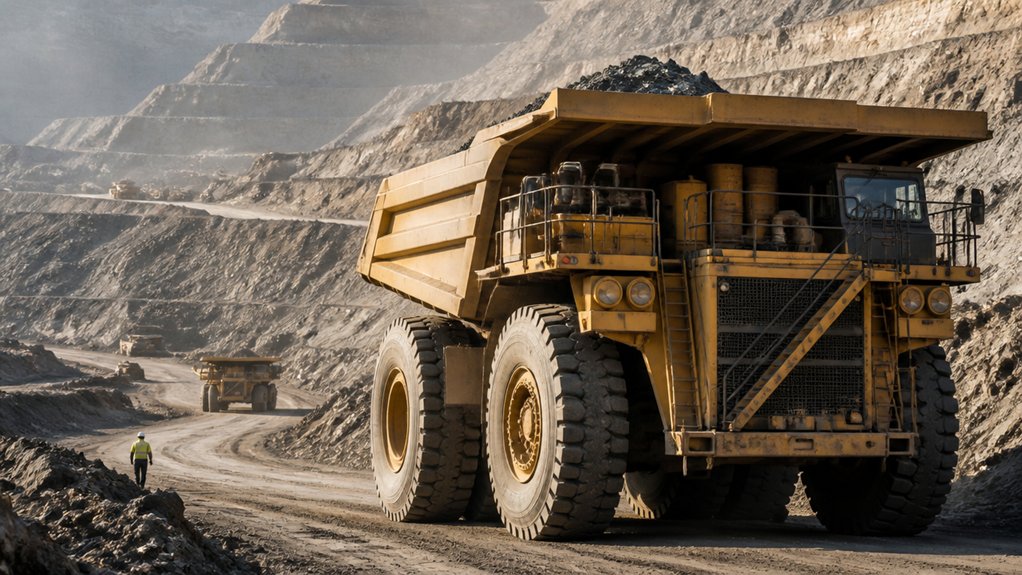
Mining dump trucks move ore and waste rock across the UK’s largest extraction sites, carrying hundreds of tonnes per journey. Their reinforced frames, oversized axles, powerful engines and wide tyres help you maintain stability on steep, uneven haul roads. You’ll find rigid, articulated and low-profile underground models, chosen to suit payloads and site conditions. Excavators load each truck before it follows a dispatched route to a crusher or stockpile. The sections below explain how these giants support safe, productive mining.
What Makes Mining Dump Trucks So Massive?

Mining dump trucks are massive because they must carry hundreds of tonnes of rock across rough, steep mine roads without compromising stability or reliability. Their scale gives you the payload capacity needed to move material efficiently from UK quarries and mines, reducing journeys between excavation faces and processing areas.
A reinforced chassis, oversized axles and high-capacity suspension distribute extreme loads while resisting impact, vibration and uneven ground. Large wheels provide ground clearance and traction on gradients, while powerful engines supply the torque required to climb with a full load.
You’ll also find that braking systems must control the truck’s considerable momentum on descents. Advanced safety features, including stability monitoring and visibility aids, help protect operators.
Eco friendly innovations, such as efficient power management, can reduce fuel use and emissions without sacrificing hauling performance.
What Types of Mining Dump Trucks Are There?
Depending on your site’s haul routes, payload requirements and ground conditions, mining dump trucks generally fall into three types: rigid-frame haul trucks for high-capacity work on established roads, articulated dump trucks for rough or uneven terrain, and underground dump trucks built to operate in confined mine workings.
Rigid models suit large UK open-pit operations, where their size demands wide, engineered haul roads.
Articulated trucks use a pivoting joint and flexible chassis to maintain traction on steep, muddy or irregular ground.
Underground models have compact dimensions, low profiles and emissions controls suited to restricted headings; battery-powered options can reduce ventilation demand.
Across these classes, Electric propulsion is expanding, while Autonomous operation can support controlled, repeatable fleet use.
You’ll choose by matching truck design, payload and site constraints—not simply maximum capacity.
How Do Mining Dump Trucks Haul and Dump Loads?
On a typical haul cycle, a mining dump truck is loaded by an excavator or shovel, travels along a planned route to a crusher or stockpile, then tips its body to discharge the material.
You’ll find that operators coordinate loading to keep payload within the truck’s rated capacity, protecting components and meeting site safety procedures. Dispatch systems can assign routes and monitor cycle times, helping improve Hauling efficiency across a UK quarry or mine.
At the tipping point, the driver positions the vehicle on firm, designated ground, applies the parking brake and raises the body using hydraulic cylinders. These Dumping mechanisms lift the body so gravity releases the load through the tailgate.
You should ensure the area is clear and the body is fully lowered before the truck leaves, preventing spillage and maintaining safe, controlled operations.
How Do Mining Dump Trucks Handle Rough Terrain?
After tipping a load, a mining dump truck must return over haul roads that may be uneven, steep or loose. You’ll rely on carefully designed terrain navigation, combining a high ground clearance with wide tyres and a low centre of gravity. These features help the truck cross ruts and loose stone while reducing the risk of grounding or rollover.
Heavy-duty suspension systems absorb impacts and keep the wheels in contact with the surface, supporting traction and steering control. Your operator should adjust speed to gradients, surface conditions and visibility, avoiding sudden braking or sharp turns.
On UK sites, regular grading and drainage limit potholes, standing water and erosion. You’ll also need to check tyre condition, suspension components and braking performance before travel, since damage can compromise stability on demanding haul roads.
How Do Mining Dump Trucks Keep Mines Producing?
Mining dump trucks keep mines producing by moving ore and waste rock between the face, processing plant and spoil areas. Their payload capacity and cycle times determine how quickly you can clear working areas and feed crushers.
Dispatch systems match trucks to shovels and routes, reducing queues and keeping haulage balanced across a UK quarry or mine. Operators monitor fuel use, tyre pressure and loading to protect equipment and meet production targets.
Planned servicing limits maintenance challenges: inspections, component replacement and scheduled downtime prevent minor faults becoming costly failures. You’ll also need reliable parts, skilled technicians and contingency trucks to sustain output.
Environmental impact matters too. Efficient routing and well-maintained engines reduce fuel consumption, emissions, noise and dust, helping you meet site permits and environmental obligations without compromising production.