

Autonomous mining equipment helps you move more tonnes per operating hour by keeping haul trucks, drills and loaders productive across shifts. Coordinated routes and programmed tasks reduce queues, handover delays and inconsistent cycle times, while onboard sensors flag maintenance needs before faults cause unplanned downtime. Live fleet data helps you refine routes and spot bottlenecks, even at remote UK sites with reliable connectivity. You’ll also see how safety controls and performance measures support effective deployment and continued productivity gains.
How Autonomous Mining Equipment Boosts Productivity?
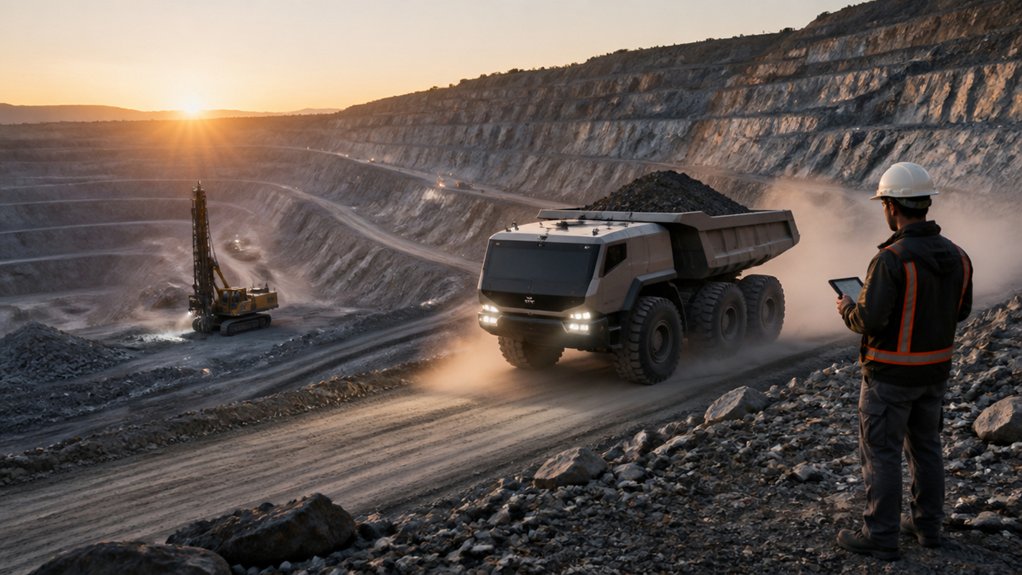
Autonomous mining equipment boosts productivity by operating continuously, following optimised routes and maintaining consistent cycle times. You can schedule machines across shifts, reducing delays linked to fatigue, handovers and limited operator availability.
On UK sites, reliable performance helps you meet production targets despite challenging weather, remote locations and tight maintenance windows.
Sensors and onboard software monitor machine health, fuel use and operating conditions. You can use this data to plan maintenance before faults cause unplanned stoppages, while integrating equipment with existing control systems supports coordinated operations.
A robust cost analysis should compare purchase, integration and training costs with expected gains in utilisation, output and equipment life. Include energy consumption and the Environmental impact of operations in your assessment.
With clear performance measures and skilled technical support, you can improve asset availability and make production planning more predictable across demanding mining operations.
Where Driverless Haul Trucks Improve Material Flow?
On UK mine sites, driverless haul trucks can shorten haul cycles by following optimised routes and maintaining steady speeds.
You’ll reduce traffic bottlenecks at loading points, haul roads and crushers through coordinated dispatch.
Their predictable runs help deliver a consistent flow of material to processing.
Faster Haul Cycles
Where do driverless haul trucks improve material flow?
Faster Haul Cycles
On a UK quarry or opencast site, autonomous haul trucks can shorten each cycle by travelling consistently between loading faces, dumps and crushers. You can programme safe speeds, routes and loading sequences, then coordinate dispatch with shovel availability and processing demand. Unlike a human-operated fleet, trucks don’t lose time to shift changes or fatigue, helping you sustain planned operating hours across the day and night.
Use fleet-management data to compare payload, travel time, queueing and fuel or energy use. This lets you identify delays and refine routes without compromising safe operation.
You’ll still need to meet Mining regulations, maintain competent oversight and assess Environmental impact, including emissions, noise and ground disturbance.
Faster cycles can raise tonnes moved per shift, but performance depends on reliable communications, suitable site infrastructure and disciplined maintenance.
Reduced Traffic Bottlenecks
When haul routes cross at loading faces, crushers and tipping points, driverless trucks can reduce bottlenecks by following coordinated right-of-way rules and dispatch instructions. With a fleet management system, you can assign priority at junctions, set safe separation distances and prevent opposing vehicles from entering narrow sections together.
Sensors and site maps help trucks detect queues, stopped equipment and changing road conditions, while dispatchers can adjust access rules as work progresses. This reduces Traffic congestion around crushers, shovel positions and tipping bays, where poor coordination can restrict other plant and support vehicles.
Effective route optimization also lets you direct trucks along suitable haul roads, avoiding conflicts with graders, water carts and maintenance crews. On UK sites, you’ll need these controls to reflect local traffic plans, operating procedures and changing ground conditions.
Consistent Material Delivery
How can driverless haul trucks keep material moving steadily? They follow programmed routes between loading faces, crushers and stockpiles, maintaining predictable cycles across UK quarry and mine sites. With fewer interruptions from shift changes or operator fatigue, you can keep ore and aggregates flowing to processing plant at a consistent rate.
Integrated fleet-management systems allocate trucks according to shovel availability, payload targets and haul-road conditions. Live telemetry helps you spot queues, adjust dispatch and respond to changing ground conditions before they disrupt production. This supports tighter coordination across Material handling, from excavation through tipping, while reducing idle time and uneven crusher feed.
Reliable delivery still depends on well-planned Equipment maintenance. Condition monitoring can flag faults early, helping you schedule servicing and protect fleet availability. By aligning routes, loading and maintenance, you can improve throughput and make production plans more dependable.
How Automated Drilling Speeds Mine Development?
Automated drilling accelerates mine development by positioning rigs accurately, drilling to programmed depths and angles, and repeating patterns with less manual intervention. You can use this consistency to prepare development headings for charging, blasting and excavation with predictable geometry.
Drill precision helps you control hole spacing, burden and alignment, supporting effective blast design in hard-rock mines. By reducing variation between planned and drilled patterns, automated rigs can improve fragmentation and limit overbreak, helping you use explosives and ground support more efficiently.
Automation integration links drill plans with mine-survey data and fleet systems, so your operators can verify set-up against current designs. In UK operations, you can adapt parameters to local geology, ventilation constraints and site safety procedures.
Clear digital records also help you review drilling performance and refine future development rounds. This gives your team a repeatable basis for advancing underground workings.
How Autonomous Equipment Cuts Delays and Downtime?
Autonomous equipment can cut delays by coordinating haul trucks, loaders and drills around live production data rather than fixed schedules. This opening paragraph is retained exactly as requested, though the following detail focuses on practical downtime controls rather than explaining how fleets use real-time data.
You can reduce waiting at loading points by assigning machines to planned tasks and keeping work areas clear. Automated systems can also pause equipment safely when a person enters a restricted zone, helping you avoid incidents and costly stoppages.
Maintenance scheduling can use engine hours, fault codes and component condition to bring servicing forward before a breakdown halts a shift. Your maintenance team can prepare parts and labour around planned shutdowns, reducing unplanned repairs at remote UK sites.
Operator oversight remains essential: your staff can review alerts, approve interventions and manage exceptions. With clear procedures and trained operators, you’ll keep production moving while maintaining safe, reliable operations.
How Autonomous Fleets Use Real-Time Data?
When conditions change across a UK mine, a connected fleet can use live data to adjust its next move. With sensor integration across haul trucks, drills and loading equipment, you can track payloads, engine health, location and road conditions from a central control system.
Data analytics turns these streams into practical decisions: dispatch software can reroute trucks around a blocked haul road, balance loading queues or revise cycle times as gradients and weather affect travel. You can also compare live performance with planned production targets, helping supervisors spot bottlenecks before they reduce output.
Reliable connectivity matters, particularly in remote or underground workings, so mines may combine private wireless networks with local edge processing. This gives your fleet timely instructions and keeps operational records consistent across shifts and sites.
How Autonomous Equipment Keeps Workers Safer?
By keeping people out of hazardous operating zones, autonomous equipment can reduce exposure to vehicle collisions, unstable ground and dust. In UK quarries and mines, driverless haul trucks can follow controlled routes while you monitor operations from a safer location. Remote operation lets you intervene without entering a vehicle’s path, reducing time spent near moving plant and uneven benches.
Onboard safety sensors detect people, obstacles and changing conditions, then trigger warnings or controlled stops. Geofencing can restrict machines to approved areas, while speed limits help manage traffic around loading points. These controls support site risk assessments and complement established procedures; they don’t replace competent supervision or safe systems of work.
You’ll still need clear exclusion zones and reliable communications, but automation can reduce routine exposure and help protect workers during demanding shifts.
What Mines Need to Adopt Autonomous Equipment?
To deploy autonomous equipment across a UK mine, you’ll need reliable connectivity that supports control, telemetry and safety systems underground and on the surface.
You’ll also need to train operators and maintenance teams to work with automated fleets and respond to faults. These capabilities form the foundation for a safe, effective rollout.
Reliable Connectivity
Autonomous mining equipment depends on reliable, low-latency connectivity to share vehicle positions, sensor data and control commands across a site. You need wireless networks engineered for your mine’s terrain, operating depth and production layout. Radio coverage must reach haul roads, loading areas, workshops and underground headings, where rock, machinery and changing stockpiles can obstruct signals.
Assess signal reliability across the full operating area, not just near access points. Map dead zones, test performance under load and provide overlapping coverage so equipment can maintain communication if a link fails.
Depending on your site, you may combine private LTE or 5G, Wi-Fi and leaky-feeder systems. Use resilient backhaul, network monitoring and fail-safe controls to manage outages safely.
In the UK, plan around site-specific geology, infrastructure and operational requirements, and verify latency and availability before deployment.
Workforce Training
What skills will your workforce need as autonomous equipment enters service? Your operators must learn to supervise machine fleets from control rooms, interpret telemetry and respond to alerts, rather than rely solely on cab-based controls.
Train technicians to diagnose sensors, communications links and autonomy software, while retaining strong mechanical and electrical maintenance skills. This skill adaptation helps your team manage mixed fleets safely during staged deployment.
Build remote oversight into role-specific training, including traffic management, geofencing, emergency stops and recovery procedures. Use simulators and supervised site trials to practise abnormal scenarios before equipment operates without direct intervention.
In UK mines, align competency assessments with site risk assessments, operating procedures and relevant health and safety duties. Involve workers and recognised safety representatives early; clear responsibilities and refresher training support safe, productive adoption across shifts.
How to Measure Autonomous Fleet Productivity?
Measuring autonomous fleet productivity means evaluating how reliably equipment turns planned operating time into productive tonnes, not simply counting hours worked. Track tonnes moved per operating hour, payload compliance, cycle time, queueing and availability across shifts.
Compare these figures with a matched, pre-deployment baseline, adjusting for haul distance, material type, weather and planned maintenance. In UK quarries and mines, wet ground, tight operating windows and site-specific traffic rules can affect results, so segment data by route and shift rather than relying on fleet-wide averages.
Check dispatch and machine logs against weighbridge records; investigate delays, manual interventions and safety stops. Your dashboard should show utilisation alongside maintenance costs, fuel or energy use, and Environmental impact.
Include stakeholder engagement when setting targets, so operators, engineers and site managers trust the measures and act on them.