
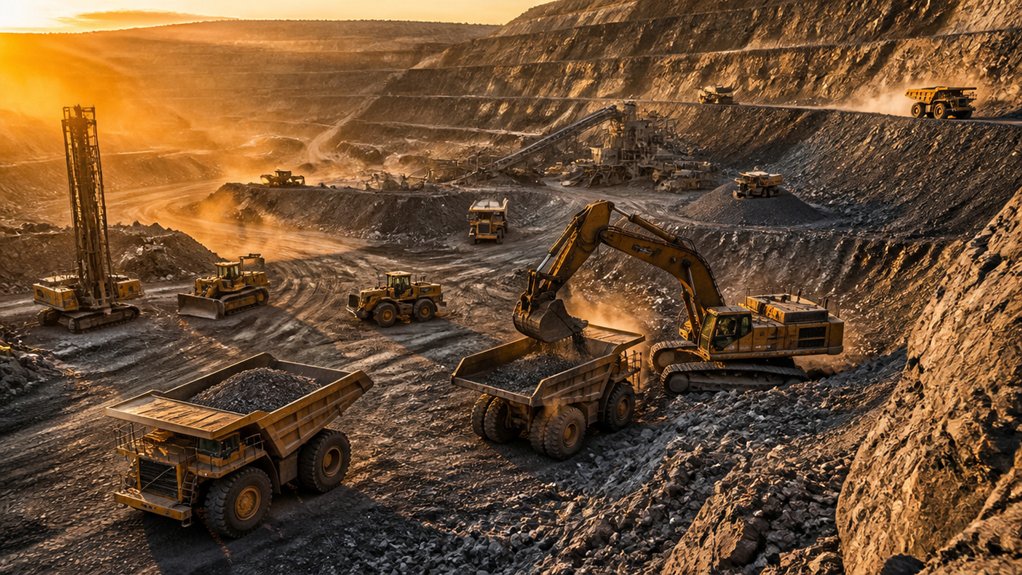
Modern mining operations use 15 essential machine types to move ore from rock to market: surface and underground drills, blasting systems, excavators, loaders, haul trucks, draglines, continuous miners, roof bolters, conveyors, crushers, screens, grinding mills, classifiers, and flotation systems. You’ll see these machines drill and break rock, stabilize workings, excavate and transport material, reduce ore size, and separate valuable minerals. Matching equipment to geology, production targets, and site conditions improves safety and throughput. The sections below explain each machine’s role.
How Mining Equipment Moves Ore From Rock to Market

Mining equipment moves ore through a coordinated chain of loading, hauling, crushing, and transport. After extraction, you use loaders or shovels to transfer material into haul trucks, which carry it to a crusher or stockpile. Match truck capacity to loading rates and haul distances to reduce queues, fuel use, and equipment wear.
At the primary crusher, large rocks become manageable fragments for conveyors or further processing. Conveyors move ore steadily to processing facilities, where screens, crushers, and separation systems prepare valuable minerals for recovery.
Effective ore processing depends on consistent feed, so monitor throughput and adjust equipment settings as conditions change.
You can track each load from the mine face to the plant using dispatch and weighing systems. Mineral exploration data helps planners anticipate ore quality and schedule suitable routes, equipment, and processing capacity.
Finally, rail or road transport delivers concentrate to customers and markets.
Surface Drills for Breaking Rock
Before loaders can move ore, surface drills create the blast holes that break solid rock into excavatable fragments. At an open pit, you’ll use rotary, down-the-hole, or top-hammer rigs, selecting a method to match rock hardness, hole diameter, and bench design.
Accurate collaring and alignment keep each hole on plan, while controlled depth and spacing support predictable blasting. Modern drill bit technology helps you match cutting structures to abrasive or fractured formations, extending service life and maintaining penetration rates.
You’ll monitor feed pressure, rotation, and flushing air to prevent bit wear, deviation, and blocked holes. These operating controls improve Rock fragmentation, reduce oversize material, and help limit vibration and flyrock.
Consistent drilling also supports safer blast patterns and more efficient loading, crushing, and haulage across the mine site.
Underground Drills for Narrow Workings
In narrow underground workings, compact drill rigs create blast holes without sacrificing control in confined headings and stopes. You can select a rig based on tunnel dimensions, rock conditions, and the required hole pattern.
Narrow tunnels often call for low-profile equipment with a short turning radius, adjustable boom, and stable feed. These features help you position the drill accurately while limiting interference with ventilation ducts, services, and nearby machinery.
Precision drilling depends on consistent alignment, controlled feed pressure, and reliable depth measurement. You should check the drill steel, couplings, and flushing system before each shift; worn components can reduce accuracy and slow production.
Match the bit and rotation settings to the rock, then monitor penetration for signs of deviation or excessive wear. A well-maintained rig helps you meet the mine plan and work safely in restricted spaces.
Blasting Equipment for Breaking Rock Safely
You use blast hole drills to create accurately positioned holes that support controlled rock breakage.
Explosives handling systems help you transport, load, and initiate charges while limiting exposure and misfires.
Match both systems to the blast design and site safety procedures.
Blast Hole Drills
How do mines break hard rock safely and efficiently? Blast hole drills create precise openings that support controlled rock fragmentation. You’ll find these machines in surface and underground operations, where crews select drill types to match rock conditions, hole diameter, and required depth.
Rotary drills use a rotating bit and downward force to penetrate hard formations. Percussion drills strike the rock repeatedly, while down-the-hole systems combine impact and rotation for deep, straight holes. Your operators monitor alignment, penetration rate, and drilling parameters to maintain accuracy and limit deviation.
Proper hole spacing and depth help produce consistent breakage and reduce oversize material.
Dust suppression, noise controls, stable positioning, and routine inspections protect workers and equipment. When you match the drill to the geology and maintain it correctly, you improve productivity, support safer blast patterns, and control operating costs.
Explosives Handling Systems
Once blast hole drills create the pattern, explosives handling systems help crews load and initiate charges under controlled conditions. You’ll use bulk trucks, charging units, and approved detonators to place the specified explosive quantity in each hole.
Metering equipment controls loading rates, while remote firing systems let authorized personnel initiate blasts from protected locations.
Follow site safety protocols at every stage: verify hole conditions, confirm exclusion zones, maintain communications, and account for all materials before and after loading.
Store explosives in secure, designated storage solutions that meet regulatory requirements; separate incompatible products and restrict access.
Trained blasters must inspect equipment, document quantities, and coordinate timing with nearby crews.
After firing, wait the required clearance period, then inspect for misfires before anyone enters the blast area.
These controls reduce exposure, improve fragmentation, and protect your operation.
Surface Excavators for Digging and Loading Ore
On surface mines, excavators dig ore and load it into haul trucks for transport to processing plants or waste areas. You’ll select a machine based on material hardness, bench height, bucket capacity, and required production rate.
Hydraulic excavators offer precise control for selective digging, while rope shovels suit high-volume work in large, established pits. Match the bucket and cutting edge to the ore and ground conditions; correct sizing improves digging efficiency and limits wear.
Position the excavator on stable, level ground, and keep the working face within the machine’s reach. Coordinate truck placement and loading cycles to reduce idle time without compromising safe clearance.
Inspect hydraulic systems, tracks, cables, and teeth regularly. Monitor payloads and face conditions so you can adjust digging methods before they affect output or equipment reliability.
Front-End Loaders for Moving Mined Material
When flexibility matters, front-end loaders move blasted ore, waste rock, and stockpiled material over short distances or load it into haul trucks and crushers. You can reposition them quickly as faces, stockpiles, and loading points change, making them useful across varied mine layouts.
Choose bucket capacity and machine size to match material density, haul-truck dimensions, and ground conditions. Hydraulic systems power the lift and tilt functions, so inspect hoses, cylinders, and connections for leaks or wear before each shift.
Keep tires properly inflated and select suitable tread for traction on rough, uneven surfaces. For operating safety, maintain clear sightlines, use a spotter in congested areas, and keep people outside the loader’s turning and bucket zones.
Don’t exceed rated loads; carry the bucket low while traveling to improve stability and control.
Draglines for Large-Scale Surface Mining
For large-scale surface mines, draglines remove overburden by using a long boom and a suspended bucket to excavate and cast material away from the coal or ore seam. You’ll find these machines especially effective where thick waste layers cover broad, relatively flat deposits.
Their large buckets and extended reach let you strip substantial areas without repeatedly moving the machine, reducing haulage requirements. Operators control bucket motion through hoist and drag ropes, while walking mechanisms reposition the heavy structure across the pit.
Although Hydraulic systems support some functions, major draglines often rely on electric drives and mechanical rope systems.
Plan digging sequences carefully to maintain stable pit slopes and efficient casting. You must also manage the Environmental impact by controlling dust, protecting drainage, and restoring disturbed land as mining advances.
Continuous Miners for Underground Extraction
Continuous miners cut and gather coal in a single, coordinated operation, making them well suited to room-and-pillar mines. A rotating drum fitted with picks breaks coal from the face; a gathering head collects it and feeds a conveyor for transport.
You can use these machines to advance entries efficiently, but you must match cutting width and power to seam thickness, hardness, and mine layout. Effective ventilation and dust suppression help control airborne hazards and heat during operation.
Automation advancements, including remote control and machine guidance, can improve positioning, consistency, and operator safety, especially in restricted areas.
You should also assess environmental impacts: cutting generates dust, noise, and waste rock, while electricity use affects the operation’s footprint.
Regular inspection of picks, conveyors, and cutting systems helps limit downtime and maintain production.
Roof Bolters for Securing Mine Tunnels
Roof bolters stabilize mine tunnels by installing steel bolts that anchor loose rock to stronger strata above. You’ll use these machines immediately after excavation, when exposed roofs and ribs need support before crews advance. Their drilling heads bore holes to specified depths, while automated systems insert and tension bolts.
Depending on ground conditions, you can select resin-grouted, mechanical-anchor, or cable bolts to reinforce fractured rock and maintain clearance.
For effective mine stabilization, match bolt length, spacing, and pattern to the geotechnical plan. You should verify drilling alignment, resin mixing, and installed tension, then inspect the supported area for cracks or movement.
Modern Roof bolters often include operator protection, remote controls, and monitoring systems that improve precision in confined headings. Regular maintenance of booms, feed rails, and hydraulic systems keeps installation reliable and reduces downtime.
Follow site procedures and ground-support standards.
Haul Trucks for Transporting Ore and Waste
How do haul trucks keep a mine’s production moving? They carry blasted ore and waste between loading points, crushers, stockpiles, and designated dumps.
For reliable ore transportation, you need to match truck capacity to excavator output, road conditions, and haul distance. Oversized trucks can raise fuel use and strain roads; undersized units may create loading delays.
Haul trucks operate on planned routes, where grades, turning radii, and surface quality affect cycle times and safety.
Before each shift, inspect tires, brakes, steering, lights, and payload systems.
Dispatch software can assign routes, track location, and reduce queueing at shovels and dump points.
You’ll also need to manage payloads within rated limits to protect components and maintain stability.
Regular maintenance, trained operators, and clear traffic controls help keep material moving while limiting downtime, collisions, and operating costs.
Underground Loaders for Mucking in Tight Spaces
When you muck in narrow headings, compact underground loaders maneuver where larger machines can’t. Their low profile and tight turning radius help you work safely around confined faces.
Efficient mucking cycles keep ore moving and reduce delays between loading and haulage.
Compact Loader Design
In narrow underground headings, compact loaders muck efficiently by combining a short chassis, tight turning radius, and low profile. This geometry lets you position the machine within confined drifts while preserving clearance beneath services and rock projections.
A compact loader’s articulated frame helps you steer around corners without requiring excessive working room. Choose a bucket sized to the heading, so you can fill it without striking the walls or overloading the machine.
Check overall width, height, and turning dimensions against surveyed access routes before purchase. Design innovation also improves operator protection and control: enclosed, low-profile cabs, clear sightlines, and responsive steering help you work safely in restricted spaces.
Match tire or track configuration to floor conditions, and verify ground clearance, service access, and component durability for your mine’s operating environment.
Efficient Mucking Cycles
Compact dimensions help an underground loader reach the face, but an efficient mucking cycle depends on how quickly it can load, reverse, haul, and return within the available heading. You can improve cycle time by matching bucket capacity to the haul distance and keeping travel routes clear.
Position the loader squarely at the muck pile, fill the bucket without excessive digging, then reverse smoothly to protect tires and avoid wall contact. Coordinate loading with truck or ore-pass availability so you don’t waste time waiting at the dump point.
Automated systems can monitor machine location, payload, and cycle duration, helping you identify delays and adjust operating practices. Maintain tires, brakes, and hydraulics to preserve performance.
Choose battery-electric equipment where suitable to support eco-friendly practices and reduce underground exhaust and heat.
Conveyors for Continuous Material Transport
Conveyors move ore, waste rock, and other bulk materials continuously between mining and processing stages. You can use belt systems to connect loading points, transfer stations, stockpiles, and plant feed areas, reducing reliance on haul trucks over fixed routes.
Select belt width, speed, and drive capacity to match your required throughput, material properties, and operating distance. Chutes and transfer points need careful design to limit spillage, dust, and impact damage.
Variable-speed drives help you coordinate flow with upstream loading and downstream handling, while sensors can detect belt misalignment, overloads, or slippage.
Plan Conveyor maintenance around inspections of belts, idlers, pulleys, and drives; replace worn components before failures interrupt production.
Apply conveyor safety controls, including guards, emergency-stop cords, lockout procedures, and clear access routes, so your crews can operate and service equipment safely.
Crushers for Reducing Rock Size
Crushers reduce run-of-mine rock to sizes suited to transport, handling, and mineral processing. You’ll typically encounter jaw crushers at primary stages, where they accept large, irregular feed. Gyratory crushers handle high throughputs in large operations, while cone and impact crushers provide further size reduction as conditions require.
Choose equipment to match your feed size, hardness, abrasiveness, and target product. Correct settings and steady feeding support consistent rock fragmentation and improve crushing efficiency. Monitor wear on liners, jaws, and other contact surfaces; worn parts can raise energy use and produce uneven material.
Use screens to separate correctly sized rock and return oversize for another pass. Keep guards, interlocks, and dust controls in service, and follow lockout procedures before maintenance. These practices protect workers, limit unplanned downtime, and deliver a reliable feed for downstream processing.
Grinding Mills for Preparing Ore
After crushing, you use grinding mills to reduce ore to the particle size required for separation. Choose among designs such as ball, rod, and autogenous mills based on ore properties and process requirements.
Each mill uses a different grinding mechanism, so match its capacity and operating conditions to your target size.
Mill Types and Designs
Once crushers reduce ore to a manageable size, grinding mills break it down further to prepare it for mineral separation. You’ll choose a mill design based on ore characteristics, throughput, and plant constraints.
Tumbling mills use rotating shells to move ore and grinding media. Ball mills suit fine grinding, while rod mills provide a coarser, more uniform product. Autogenous mills grind ore with ore; semi-autogenous mills add steel balls to increase grinding capacity.
For high-throughput circuits, you may use stirred mills, which apply energy efficiently to fine particles.
Check shell liners and media regularly to control wear and maintain performance. Reliable gear lubrication protects drive components, while mill automation helps you manage speed, load, and operating conditions.
Match the mill and control system to your process goals and maintenance capabilities.
Ore Size Reduction
How fine should you grind the ore? Set the target by matching mineral liberation requirements to downstream processing, not by pursuing the smallest possible particles. Your grinding mill reduces material after ore crushing, preparing it for efficient separation while controlling energy use and wear.
Choose a grind size through test work that measures mineral associations, hardness, and recovery. If particles remain too coarse, valuable minerals may stay locked in waste; if you grind too finely, you can increase power demand, create slimes, and hinder separation. Use screens, cyclones, or other classifiers to return oversize material to the mill and advance correctly sized particles.
Monitor feed rate, mill load, and product samples. Consistent particle sizing helps you stabilize throughput and meet process targets. Adjust water addition and operating conditions as ore characteristics change.
Flotation Systems for Separating Valuable Minerals
Flotation systems separate valuable minerals from crushed ore by exploiting differences in how mineral surfaces interact with water and air. In Mineral flotation, you mix ground ore with water to form a slurry, then add Flotation reagents to make target minerals repel water while unwanted particles remain wet.
Air injected into the cell forms bubbles that carry hydrophobic minerals to the surface as froth. You collect this froth for further processing, while the remaining slurry exits as tailings.
Choose cell size, agitation, air rate, and reagent dosage to match ore characteristics and throughput. You’ll need to monitor pH, froth depth, and recovery because small changes can affect concentrate grade and metal yield.
Modern systems use sensors and automated controls to stabilize operation, reduce reagent waste, and maintain consistent separation as feed conditions change.