
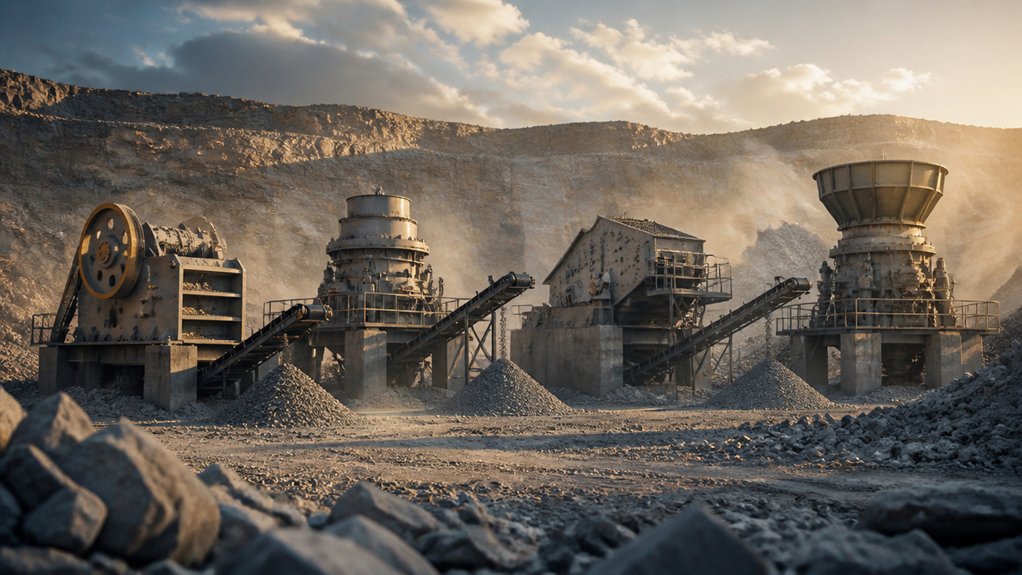
Choose a quarry crusher by matching rock hardness, abrasiveness, feed size, and production targets. Use a jaw crusher for primary reduction of large rock, a cone crusher for hard, abrasive material, and an impact crusher for softer stone or better-shaped aggregate. Select a gyratory crusher when you need high-volume, continuous throughput. Check capacity, product gradation, fines, wear-part costs, and downstream limits before deciding. The comparisons that follow can help you narrow the options for your operation.
Compare Quarry Crushers by Material, Capacity, and Cost
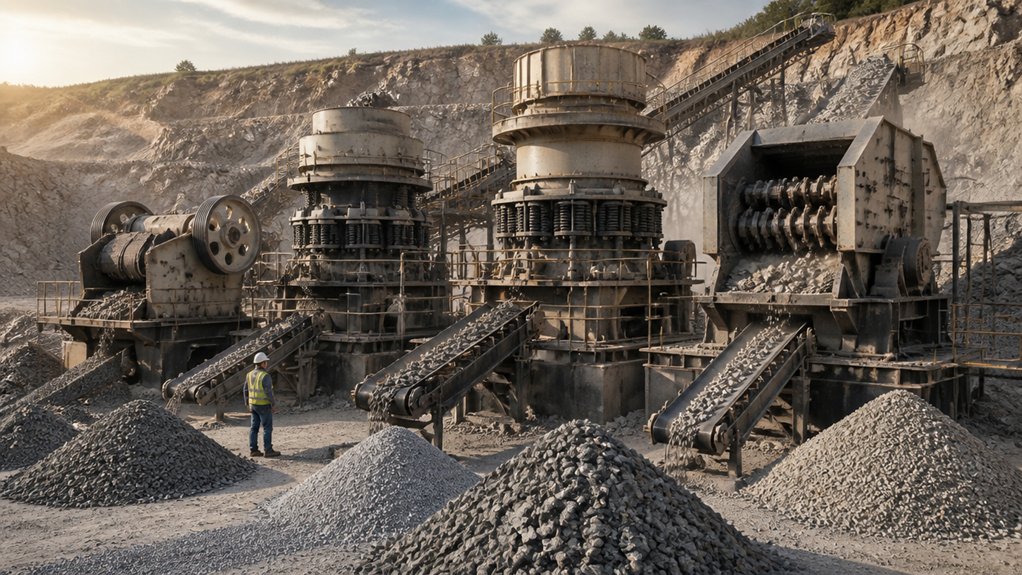
Compare quarry crushers by matching the machine to your feed material, required throughput, and operating budget. Assess hardness, abrasiveness, moisture, and variability using representative samples. These properties affect wear, energy use, product consistency, and operating costs, so don’t rely on rock names alone.
Estimate your production target in tons per hour and account for peak demand, planned downtime, and downstream capacity. A crusher that meets average output may constrain the plant during busy periods; oversized capacity can raise purchase and energy costs without improving results.
Compare total ownership costs, including installation, power, wear parts, labor, and maintenance requirements. Check local parts availability and service support before buying.
Also evaluate Environmental impact: dust, noise, emissions, and water use may affect permits and community relations. Choose the option that meets production needs reliably while fitting your budget and site constraints.
Match Quarry Crusher Types to Feed Size
Feed size determines which quarry crusher can accept material efficiently without excessive blockage, wear, or extra processing. Check the largest incoming rock dimensions against each machine’s rated maximum feed opening, then account for shape, hardness, and consistency. Your selection should also reflect the reduction ratio needed to reach the next processing stage.
Gyratory and jaw crushers generally accept larger feed than cone and impact models, while secondary and tertiary units require smaller, controlled inputs. Don’t rely on nominal opening size alone: oversized, slab-shaped pieces can bridge or strain a crusher even when they appear to fit. Use a grizzly or scalping screen to remove fines and regulate feed where needed.
Correct sizing improves quarry crusher efficiency, stabilizes throughput, and limits wear. Track feed dimensions and blockage patterns to refine maintenance strategies and adjust upstream screening.
Jaw Crushers for Primary Quarry Crushing
Once feed size points to a primary machine, a jaw crusher is often a practical choice for breaking large quarry rock. Its fixed and moving plates compress each feed load, reducing oversized material to a manageable product for downstream processing.
You can adjust the discharge setting to control output size, but check that it suits your plant’s capacity and the next stage’s requirements.
Effective Rock fragmentation starts with consistent feed; remove tramp metal and avoid overloading the chamber to limit blockages and wear.
Inspect jaw plates, bearings, and toggle components on schedule, since neglected maintenance can cut throughput and raise operating costs.
Track fuel use, dust, and noise to assess environmental impact.
A well-sized jaw crusher gives you dependable primary reduction and supports steady quarry production without unnecessary energy consumption.
Cone Crushers for Hard, Abrasive Rock
When you need to crush hard, abrasive rock, a cone crusher delivers consistent reduction under high loads.
You’ll protect throughput by matching chamber geometry and settings to your feed.
Track liner wear and adjust maintenance intervals to control costs and avoid unplanned downtime.
Crushing Hard Rock
For hard, abrasive rock, a cone crusher’s compression action delivers reliable reduction while limiting wear compared with impact-based crushing. You’ll get the best results when you match the crusher’s chamber, feed size, and closed-side setting to your material and target product.
Keep the feed continuous and evenly distributed; surges or segregation can reduce throughput and produce inconsistent gradation.
Use a primary jaw crusher when run-of-quarry rock exceeds the cone’s feed capacity, then size the cone for secondary or tertiary duty.
Check motor load, discharge flow, and product sizing during operation, and adjust settings to maintain performance as conditions change.
Plan access, guarding, and lockout procedures to support quarry safety.
Efficient crushing can also lower energy use and environmental impact by reducing recirculation and unnecessary processing.
Don’t exceed the manufacturer’s feed limits.
Managing Abrasive Wear
Hard, abrasive rock accelerates wear on cone liners, so inspect the mantle and bowl liner regularly for uneven wear, cracking, and loss of profile.
Track liner thickness and operating hours to schedule replacements before performance drops or structural damage occurs.
Abrasive materials can also wear feed plates and discharge components, so check these during planned shutdowns.
Select Wear resistant alloys suited to your rock’s hardness and abrasiveness; match liner profiles to the feed size and product specification.
Maintain a steady, well-distributed feed to prevent localized loading, and keep the chamber choke-fed when operating conditions allow.
Monitor motor power, throughput, and product shape for changes that may signal worn liners.
Set the closed-side setting correctly, and replace liners as a matched set to preserve crushing efficiency and protect the crusher.
Impact Crushers for Shaping Softer Stone
Impact crushers suit softer stone such as limestone, producing well-shaped, cubical aggregate through high-speed impact rather than compression. You’ll feed material into a rotor, where blow bars accelerate it against breaker plates. This action fractures stone along natural weaknesses and gives you consistent particle shape, often reducing the need for secondary shaping.
Choose Impact crushers when your softer stone has moderate abrasiveness; highly abrasive feed can wear blow bars and liners quickly. Check the feed’s maximum size, moisture, and clay content, since sticky material may build up and restrict flow.
Adjust rotor speed and impact-plate gaps to balance product size, shape, throughput, and wear. Inspect wear parts regularly, and replace them before performance drops. Before purchase, compare expected gradation with your specifications and confirm the machine can handle your target production rate.
Gyratory Crushers for High-Volume Quarries
When your quarry needs high, continuous throughput, a gyratory crusher can handle large feed sizes and steady production demands. Its primary crushing action suits operations that run long shifts and process substantial tonnage.
You’ll feed blasted rock directly into the crusher, where a gyrating mantle compresses material against a fixed concave surface. This design supports consistent operation under heavy loads, helping you maintain a reliable flow to downstream equipment.
To protect Gyratory efficiency, match the crusher’s feed opening and power rating to your rock and production plan. Use a stable, well-designed feed system to prevent surges, bridging, and uneven wear.
You’ll also need substantial installation space, a strong foundation, and planned access for maintenance. High volume throughput makes this option practical for large quarries, but only when your site can support its scale and operating requirements.
Compare Quarry Crusher Capacity, Shape, and Fines
Compare each crusher type’s capacity against your required throughput, since output varies with feed size and operating conditions.
Check the particle shape each machine produces to guarantee it meets your product specifications.
Also assess fines levels, because excess fines can affect yield and downstream processing.
Capacity by Crusher Type
Crusher capacity depends on feed size, rock hardness, setting, and the product you need—not just the machine’s rated throughput.
A jaw crusher handles primary reduction and accepts large feed, making it a practical choice when you need a robust front end.
A gyratory crusher suits high-volume operations with steady feed and continuous production.
For secondary or tertiary stages, a cone crusher typically delivers consistent throughput on hard, abrasive rock, while an impact crusher can process softer or less abrasive material at high rates.
Compare each unit’s capacity at your actual feed and discharge settings; tighter settings may reduce throughput and increase wear.
Also weigh energy use, dust control, and water needs when evaluating Environmental impact.
Check maintenance requirements, parts availability, and planned downtime before selecting a crusher for your target production rate.
Particle Shape Differences
Capacity tells you how much material a crusher can process, but particle shape and fines determine whether the product meets your specifications.
Jaw crushers typically produce angular, elongated particles because they compress rock along a limited number of fracture planes.
Cone crushers apply repeated compression, yielding more consistent, cubical material when you maintain the correct settings and feed distribution.
Impact crushers fracture rock through high-speed collisions, often producing well-shaped, cubical particles suited to concrete and asphalt mixes.
Gyratory crushers also rely on compression; their product shape depends on chamber design, feed characteristics, and operating conditions.
Compare samples against your required gradation and shape limits rather than relying on crusher type alone.
Check downstream handling and end-use demands, too.
Better particle shape can improve packing and crusher efficiency across your operation.
Fines Production Levels
Fines production affects product yield, dust control, and downstream processing costs. Jaw crushers typically produce fewer fines because compression breaks rock along natural planes, making them suitable when you need coarse, saleable material.
Cone crushers also rely on compression; their fines levels depend on chamber design, feed gradation, and closed-side setting.
Impact crushers create more fines through high-energy collisions, but they can deliver well-shaped aggregate when your specifications justify the trade-off.
Gyratory crushers handle high capacities with consistent reduction, while fines generation varies with operating settings and feed characteristics.
Track fines in each product fraction, then adjust crusher settings and screening circuits to meet gradation targets.
Enclosed transfer points, extraction systems, and water sprays support dust control.
Compare yield, capacity, and specification compliance before choosing equipment; the lowest fines rate isn’t always the most economical option.
Understand Quarry Crusher Wear Parts and Costs
Because wear parts directly affect uptime and operating costs, you should compare their service life, replacement price, and availability when choosing a quarry crusher.
Jaw crushers use replaceable jaw plates; cones rely on mantles and concaves; impact crushers consume blow bars and liners. Gyratory crushers need durable mantles and concaves, often with higher replacement costs.
Actual wear depends on rock hardness, abrasiveness, feed size, and operating practices, so request estimates based on your material and expected tonnage. Include labor, lifting equipment, and downtime in each cost comparison—not just the part price.
Set maintenance scheduling around inspections and measured wear, replacing components before failure damages other parts.
Confirm spare parts availability with suppliers, including lead times and local stock. Reliable supply helps you plan shutdowns and control lifecycle costs without unexpected interruptions.
Fit Your Quarry Crusher to the Production Circuit
After evaluating wear costs and parts availability, check how the crusher will fit into your production circuit. Confirm that its feed opening accepts your upstream material and that its discharge size suits the next stage. Match rated capacity to the actual flow of your screens, conveyors, and stockpiles; a mismatch can cause bottlenecks or idle equipment.
Check installation space, foundation loads, power supply, and access for service. Review how the crusher handles variations in feed size, moisture, and hardness without disrupting the circuit. Consider dust suppression, noise controls, and water use when appraising Environmental impact.
Verify maintenance requirements against your crew’s skills, service access, and planned shutdown windows. Coordinate controls and interlocks with existing equipment, then confirm safe isolation points. A well-integrated crusher supports reliable operation across the whole plant.
Choose a Quarry Crusher for Your Production Goals
Set production targets before comparing quarry crushers, since the right machine depends on the material you need to produce and the rate you need to sustain. Define your required tonnage, feed size, product gradation, and operating hours.
Then match the crusher to the duty: choose a jaw for primary reduction, a cone for consistent secondary or tertiary sizing, an impact crusher for shaping or softer rock, or a gyratory for high-capacity primary service.
Check whether the machine can meet peak demand without creating bottlenecks downstream. Factor in energy use, wear-part costs, and maintenance schedules, not just purchase price.
If you process Eco friendly materials or recycled feed, verify the crusher handles variable composition and contaminants.
Compare lifecycle costs and service support, then select capacity that meets your targets without unnecessary oversizing.