
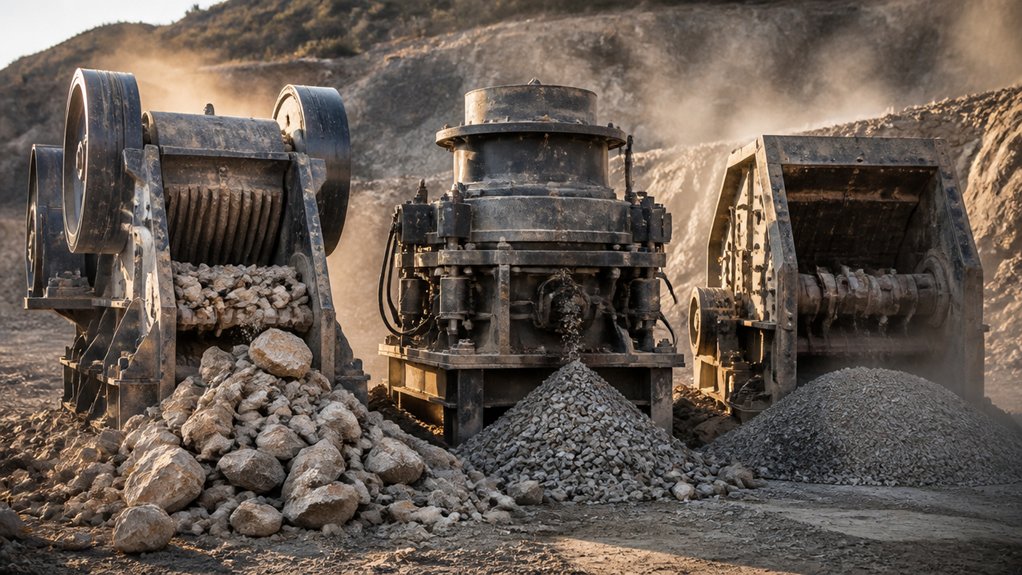
The main types of rock crushers are jaw, gyratory, cone, impact, roll, and hammer crushers. You’ll choose among them based on rock hardness, abrasiveness, feed size, moisture, and the product you need. Jaw and gyratory crushers use compression for primary reduction; cone crushers handle secondary and tertiary stages. Impact and hammer crushers use rapid blows, while roll crushers apply steady compression. Match the crusher to your material and operating conditions to control product size, wear, and cost. The sections below explain how to choose.
What Are the Main Types of Rock Crushers?

Rock crushers fall into four main categories—jaw, cone, impact, and gyratory—each using a different mechanism to reduce material. You choose among them by matching the machine to your feed, target product, and operating conditions.
Jaw crushers suit primary reduction of large, hard feed. Cone crushers handle secondary or tertiary stages, producing a controlled, consistent product. Impact crushers use rapid strikes and work well when you need shaped aggregates or process softer, less abrasive rock. Gyratory crushers serve high-capacity primary applications where steady throughput matters.
Assess Rock strength, abrasiveness, feed size, and moisture before selecting equipment. These factors affect wear, energy use, and output quality.
Consider Crushing materials requirements, including the desired particle size and downstream process. Your circuit may combine crusher types to meet production goals efficiently; compare capacity, maintenance access, and lifecycle costs before committing to a configuration.
How Do Jaw and Gyratory Rock Crushers Work?
Jaw and gyratory crushers both use compression to break rock, but their chamber designs and motion differ.
In a jaw crusher, you feed material between a fixed jaw and a moving jaw. The moving jaw swings toward the fixed one, compressing rock until it fractures; the gap then opens, letting smaller pieces drop. You can adjust the discharge opening to control product size.
A gyratory crusher uses a conical head that gyrates inside a stationary, concave bowl. As you feed rock from above, the head’s continuous circular motion compresses it against the bowl. Fragments move downward through the narrowing chamber and exit at the bottom.
These distinct crushing mechanisms rely on material compression, but gyratory action provides continuous crushing, while jaw action cycles between compression and release. You’ll select settings based on feed size and required output.
When Should You Use Cone and Impact Crushers?
When you need to produce well-shaped aggregate from hard, abrasive rock, use a cone crusher; when you need higher reduction ratios or to process softer, less abrasive material, an impact crusher may be the better choice.
For reliable selection, assess material suitability alongside product specifications. Cone crushers compress rock between a mantle and a bowl liner, making them effective for secondary and tertiary stages where consistent sizing and durability matter. Impact crushers use rapid blows to fracture feed, often producing cubical particles with fewer elongated pieces.
They can also handle variable feed, but abrasive rock can accelerate wear on impact surfaces.
Compare throughput, desired particle shape, maintenance access, and wear-part costs before choosing. These operational considerations affect availability and cost per ton. Check feed size and moisture against the machine’s limits, then match the crusher to your downstream screening and production requirements.
What Can Roll and Hammer Crushers Handle?
Roll crushers handle friable, moderately hard materials such as coal, limestone, and clay, reducing them with steady compression between rotating rolls. You can use them to produce a controlled product with fewer fines than impact-based crushing typically creates. Check feed size and moisture: sticky material can clog the rolls, while oversized pieces may exceed the machine’s capacity.
Hammer crushers suit brittle, low- to medium-hardness feed, including gypsum, coal, and limestone. Their rapidly rotating hammers fracture material against breaker plates or screens, making them useful when you need a finer output in one stage.
Material hardness affects wear and throughput; abrasive or very hard rock can damage hammers quickly. Consider crusher versatility: some models accept varied feed sizes and screen settings, but neither type handles every material efficiently. Match the crusher’s operating limits to the material’s properties.
How Do You Choose a Rock Crusher for Your Job?
Choosing a rock crusher starts with the material and the product you need, not just the machine type. Check the feed’s hardness, abrasiveness, moisture, and maximum size. These properties affect wear, throughput, and the rock fracture process.
Match the crusher to your required output size and shape, then decide whether you need primary, secondary, or tertiary reduction.
Consider your site conditions, too. Confirm available power, space, access, and support equipment, including feeders and conveyors. For mineral extraction, select a configuration that meets processing targets without excessive fines or costly wear.
Compare capacity at your actual feed size, not only the rated maximum. Finally, weigh purchase price against energy use, maintenance intervals, spare-parts access, and operator skill.
A properly sized, well-supported crusher will deliver reliable production and lower lifecycle costs.