
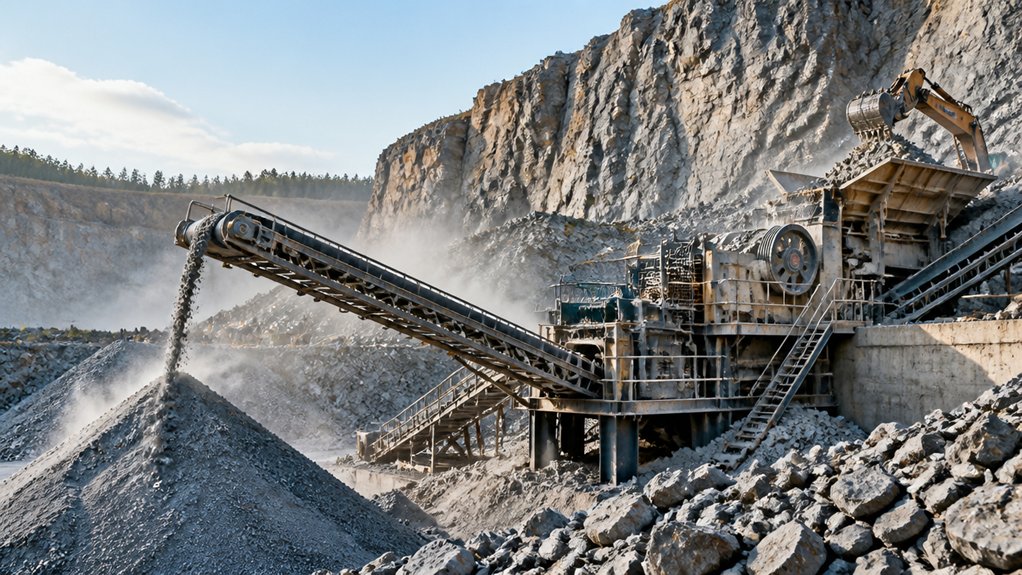
The best rock crushers for quarry production depend on your material, feed size, output targets, and site conditions. Choose a jaw crusher for primary crushing of large, hard rock; use a cone crusher for abrasive material and controlled secondary or tertiary sizing; select an impact crusher for softer stone and well-shaped aggregate. Match capacity across the circuit, including screens and conveyors, and compare energy, wear, maintenance, and uptime costs. The guidance below helps you refine your selection.
Match Rock Crushers to Production Goals

Match a rock crusher to your production goals by starting with the material you need to process and the output you need to produce. Define your target tons per hour, feed size, finished gradation, and operating schedule before selecting equipment.
Then assess the material’s hardness, abrasiveness, moisture, and variability; these factors affect wear, throughput, and downtime.
Your site layout, power supply, and available maintenance support also shape a practical choice.
Use rock crusher technology that can meet demand without sacrificing aggregate quality or creating unnecessary operating costs. Check performance data at your expected feed conditions, not just maximum rated capacity.
Allow for peak production needs, but avoid oversizing equipment that will run inefficiently at typical loads.
Set measurable goals for product consistency, energy use, and uptime, then verify them against operating records after installation.
Your crusher should fit the job, not dictate it.
Compare Jaw, Cone, and Impact Crushers
Once you’ve defined your production targets, compare crusher types by how they handle your feed and shape the finished product. Jaw crushers use compression to break hard, abrasive rock into coarse, angular material.
Cone crushers also compress rock, typically refining intermediate feed into consistent, smaller aggregate with good control over gradation. Impact crushers use high-speed collisions, producing cubical particles and more fines; they suit softer or less abrasive materials but can wear quickly on tough feed.
Consider Rock durability when you select wear parts and estimate operating costs. For abrasive stone, compression crushers often deliver longer service life. For friable rock, impact crushing can improve shape and reduce extra processing.
Check the required product specification, throughput, and maintenance demands for each option. Also assess Environmental impact, including energy use, dust, noise, and the amount of recirculating material your circuit will generate.
Choose a Primary Crusher for Large Feed
For large, run-of-mine feed, choose a primary crusher with an intake opening sized for your largest rocks and enough capacity to meet target throughput. Check the mine plan’s maximum lump size, not just its average, and allow clearance for irregular shapes.
Strong Feed compatibility depends on matching the crusher’s opening, chamber, and operating limits to your material’s hardness, abrasiveness, moisture, and clay content. A jaw crusher often suits tough, coarse feed and handles variable rock sizes; confirm its rated capacity at your actual setting.
For Primary selection, compare required throughput, reduction ratio, power demand, and maintenance access. Verify that the feeder can deliver rock evenly without overloading the chamber, and assess whether trucks or loaders can feed it safely.
Size the installation for peak conditions, while accounting for wear and downtime.
Select a Secondary Crusher for Consistent Sizes
To produce consistent product sizes, select a secondary crusher that can handle the primary crusher’s discharge and meet your target gradation. Match the crusher’s feed opening and capacity to your material’s size, hardness, and hourly tonnage.
A cone crusher suits abrasive, hard rock and offers reliable control through adjustable closed-side settings. An impact crusher can process softer, less abrasive stone when you need a cubical shape, but monitor wear and operating costs.
Use secondary screening to separate on-spec material from oversize and return only the latter for another pass. This closed circuit helps you maintain size consistency as feed conditions change.
Set the screen aperture and crusher settings together, then verify gradation with regular samples. Track throughput, wear, and product curves so you can correct drift before it affects downstream handling or customer specifications.
Use Tertiary Crushers for Finer Aggregate
When secondary crushing leaves aggregate coarser than your specification, a tertiary crusher can reduce it to finer, more uniform sizes. Tertiary crushers handle this final size reduction, helping you meet gradation targets for concrete, asphalt, and other applications.
Choose a cone crusher for controlled, consistent output, or an impact crusher when particle shape matters. Set the closed-side setting to control product size, then verify results with routine sieve analysis.
A recirculating circuit can return oversize material for another pass, improving product consistency. Monitor feed rate, wear parts, and discharge conditions; fluctuations can affect both capacity and gradation.
Don’t overcrush: excessive fines may lower yield and require additional screening. Match crusher settings and screen openings to your required product specifications, and adjust them as operating conditions change.
Choose Rock Crushers for Your Material
Choose a crusher suited to your material’s hardness to limit wear and maintain throughput.
Check that its feed opening accommodates your largest rocks.
Account for moisture and abrasiveness, which can affect flow, wear, and crusher performance.
Match Crusher to Hardness
Match the crusher to your material’s hardness and abrasiveness to limit wear and maintain efficient production. Assess rock strength and mineral composition, since quartz-rich or highly abrasive stone can accelerate wear even when its hardness seems moderate.
For hard, abrasive rock, choose a compression crusher, such as a jaw or gyratory unit for primary reduction, then a cone crusher for secondary stages. These machines handle high crushing forces and generally resist abrasive service better than impact crushers.
If you process softer, less abrasive material, an impact crusher can deliver efficient reduction and a well-shaped product, but expect faster wear on hard stone.
Check wear-part options, operating costs, and the manufacturer’s material guidance before selecting equipment. Match the machine to your actual geology, and you’ll protect uptime, control maintenance, and sustain output.
Consider Feed Size
After matching crusher type to rock hardness, check the maximum feed size your operation needs to process. Compare the largest incoming pieces with the crusher’s rated opening and allowable feed dimensions. Oversized rock can bridge at the inlet, interrupt flow, or overload components, reducing throughput and increasing wear. Don’t rely on average dimensions; assess the largest pieces you’ll routinely handle.
Your feed size also affects the crushing stages you need. A primary crusher must accept run-of-quarry material, while secondary and tertiary units require smaller, more consistent feed. Plan material fragmentation across stages so each crusher reduces rock to a size its successor can process efficiently.
Check the manufacturer’s recommended feed-to-product ratio and confirm your target output fits the machine’s capacity. If incoming blocks exceed limits, use a suitable primary unit or pre-break them before feeding downstream equipment. This keeps production stable.
Check Moisture and Abrasiveness
Moisture and abrasiveness can affect crusher performance as much as rock hardness. Check your material’s moisture content before selecting equipment. Wet, sticky feed can bridge in hoppers, clog screens, and coat crusher surfaces, reducing throughput and increasing downtime.
If you process damp material, consider a design with effective clearing access and suitable screening or feeding systems. Dry, free-flowing rock generally moves more consistently through the crushing circuit.
Complete an abrasiveness assessment using representative samples and, where available, wear data from similar operations. Highly abrasive stone can accelerate wear on liners, blow bars, and other contact surfaces.
You’ll need to compare crusher types by wear-part life, replacement cost, and maintenance access—not purchase price alone. Match chamber design and operating settings to the material, then monitor wear and production to confirm your choice.
Compare Crusher Capacity, Costs, and Maintenance
When comparing rock crushers, look beyond rated capacity to the cost of producing each ton and the maintenance it requires. Check throughput at your target feed size and material hardness; a machine’s peak rating won’t predict sustained output.
Compare purchase price, power use, wear-part consumption, and labor over the crusher’s service life. Ask suppliers for operating data from similar quarry conditions, including downtime and tons processed between liner changes.
Assess access to wear parts, inspection points, and service support before you buy. A design that simplifies routine checks can reduce stoppages and protect production.
Automation upgrades may improve monitoring and limit unnecessary energy use, but verify their cost and compatibility.
Include environmental impacts, such as noise, dust, and emissions, in your evaluation. Choose the crusher that meets your production target reliably at the lowest realistic lifecycle cost.
Design an Efficient Quarry Crushing Circuit
Match each crusher to your feed’s hardness, abrasiveness, and size distribution.
Balance stage capacities to prevent bottlenecks, then tune screening and recirculation to meet product specifications without excess re-crushing.
Match Crushers to Material
To design an efficient quarry crushing circuit, choose each crusher for the material’s hardness, abrasiveness, feed size, and target product. Examine the rock formation and mineral composition before selecting equipment; these properties determine wear rates, fracture behavior, and suitable crushing methods.
For hard, abrasive granite or basalt, use a jaw crusher for primary reduction, then consider a cone crusher for secondary or tertiary stages. Fit durable wear parts and monitor their condition.
For softer, less abrasive limestone, an impact crusher can produce well-shaped aggregate with fewer stages. If your feed contains clay or moisture, prevent sticky material from blinding screens or choking the crusher; use suitable grizzly bars or pre-screening.
Match the crusher’s maximum feed opening to your largest pieces, and set discharge openings to meet product specifications without unnecessary fines. Test representative samples before final selection.
Balance Circuit Capacity
Balance every stage of the crushing circuit to the plant’s target throughput, since a bottleneck at any crusher, screen, or conveyor limits total production. Start by measuring each machine’s rated capacity against actual feed rates, product requirements, and operating hours.
Then size upstream and downstream equipment to handle peak flow without forcing crushers to run below their efficient range. Check conveyor width, motor power, transfer points, and surge-bin volume; insufficient capacity at any point can interrupt production or create unsafe buildup.
Use reliable operating data to identify constraints, and allow practical headroom for variable feed and planned maintenance.
Circuit optimization also means coordinating equipment settings and control systems so each stage responds to changing loads. With disciplined Capacity balancing, you’ll improve utilization, stabilize output, and avoid costly overloading throughout the plant.
Optimize Screening and Recirculation
Set screen openings and deck area to separate material at the required cut size without restricting crusher throughput. Match screen capacity to peak feed, not average flow, and select media that resists blinding with your material’s moisture and shape.
Monitor Screening efficiency through product gradation, oversize carryover, and deck loading; adjust feed distribution, spray bars, or aperture size when performance slips. Keep Recirculation systems short and controlled. Return oversize to the appropriate crusher, and size conveyors and chutes for the combined fresh and circulating load.
Excessive recirculation wastes power, accelerates wear, and can overload upstream equipment. Track circulating load and screen differential trends during operation. If the loop grows, check screen condition, crusher settings, and feed consistency before increasing capacity.
Balance cut accuracy with stable flow to protect product quality and equipment availability.